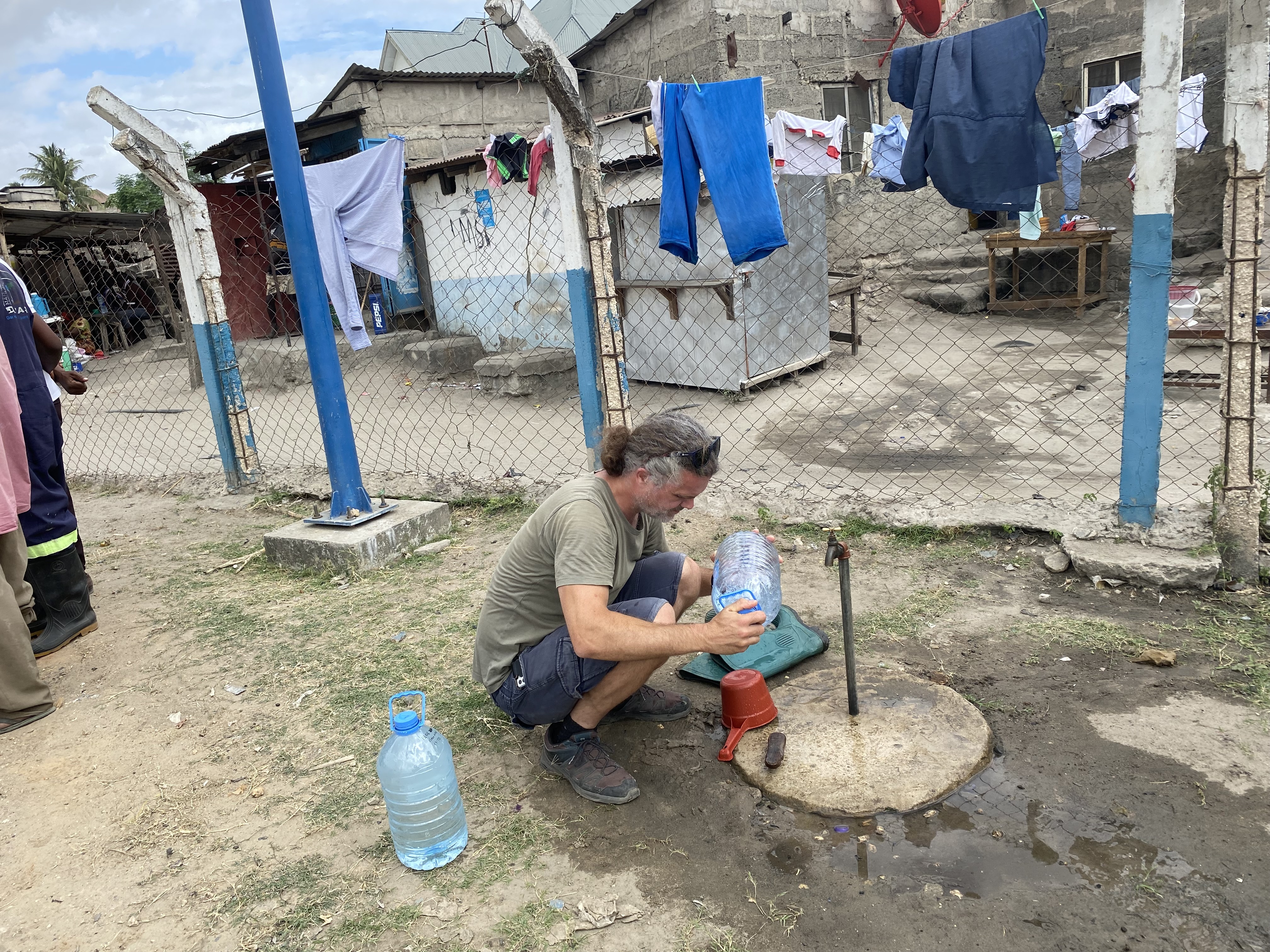
ODIN will develop/strengthen a genomic environmental surveillance system that relies on monitoring waterborne pathogens in wastewaters and other environmental reservoirs. In addition, the project will strengthen the capacity for genomics and bioinformatics database management in sub-Saharan Africa.
Objectives
The ODIN project aims to:
- Develop a genomic surveillance system based on environmental monitoring, serving as an early warning system for waterborne pathogens and antimicrobial resistance (AMR) in outbreak situations.
- Strengthen genomics and bioinformatics capacity in sub-Saharan countries.
- Strengthen international multidisciplinary research and cooperation.
- Reduce disease and illness cases caused by contaminated drinking water in sub-Saharan Africa by increasing awareness and providing protocols for efficient water and sanitation interventions (SDG6).
Implementation
The ODIN project involves seven work packages:
- Project Management, Coordination, and Leadership (coordinated by Lund University)
- Setting up environmental surveillance systems for multiple human pathogens
- Human pathogen surveillance using a mobile and semi-autonomous environmental workflow (led by NORCE)
- Developing metagenomic and bioinformatic analytical processes with interactive visualisation and sharing endpoints
- Integration of translational pathogen genomics into public health surveillance systems
- Capacity strengthening, knowledge mobilisation and training in genomics and bioinformatics
- Dissemination, Communication and Exploitation of the Results
NORCE's Contribution
NORCE leads the work package on a mobile, semi-autonomous environmental workflow (WP3). The aim is low-cost, easy-to-implement analysis of environmental samples for epidemiological surveillance, as part of a One Health approach to disease prevention, control and public health preparedness. In this work package NORCE has developed a modular mobile laboratory for metagenomic sequencing (Oxford Nanopore) and quantitative PCR (qPCR), together with open-source software that turns raw data into interpretable results. The software is driven by structured sample metadata. Each sample is registered once, and that record controls how the data are processed, pooled and reported. Taxonomic profiles, antimicrobial resistance genes and qPCR results therefore stay linked to the same sample across runs, flow cells and countries. A local web application shows results as they are produced and works without an internet connection. The pipelines, the metadata model and the web application are available under an open-source licence (AGPL).
In September 2025 the mobile laboratory was deployed in Dar es Salaam, Tanzania. Over one month the team analysed wastewater, drinking water, surface water and soil. They sequenced 81 samples, analysed 69 by qPCR, and trained and certified 25 scientists from four African countries.
ODIN-Mpox
ODIN-Mpox (August 2024 – July 2026) extended ODIN to mpox, after the outbreak in the Democratic Republic of the Congo, which declared a public health emergency in April 2024. The extension set up genomic surveillance of mpox virus in wastewater and other water sources in the DR Congo and neighbouring countries. Its aims were to detect the virus early, to identify the sublineages that drive case numbers, and to provide information for targeted vaccination. NORCE extended the mobile laboratory to mpox with qPCR assays for orthopoxviruses and mpox virus, which were used in the Dar es Salaam deployment in 2025. ODIN-Mpox was funded by Horizon Europe and Global Health EDCTP3 (grant agreement no. 101195186).
Partners
- Lund University (LU), Sweden (coordinator)
- National Institute for Medical Research (NIMR), Tanzania
- Centre National de la Recherche Technologique et Scientifique (CNRST/IRSS-DRCO), Burkina Faso
- University of Kinshasa (UNIKIN), the Democratic Republic of Congo
- Flanders Institute for Biotechnology (VIB), Belgium
- Ghent University (UGENT), Belgium
- Norwegian Research Centre (NORCE), Norway
- The Global Health Network (TGHN), University of Oxford, United Kingdom
