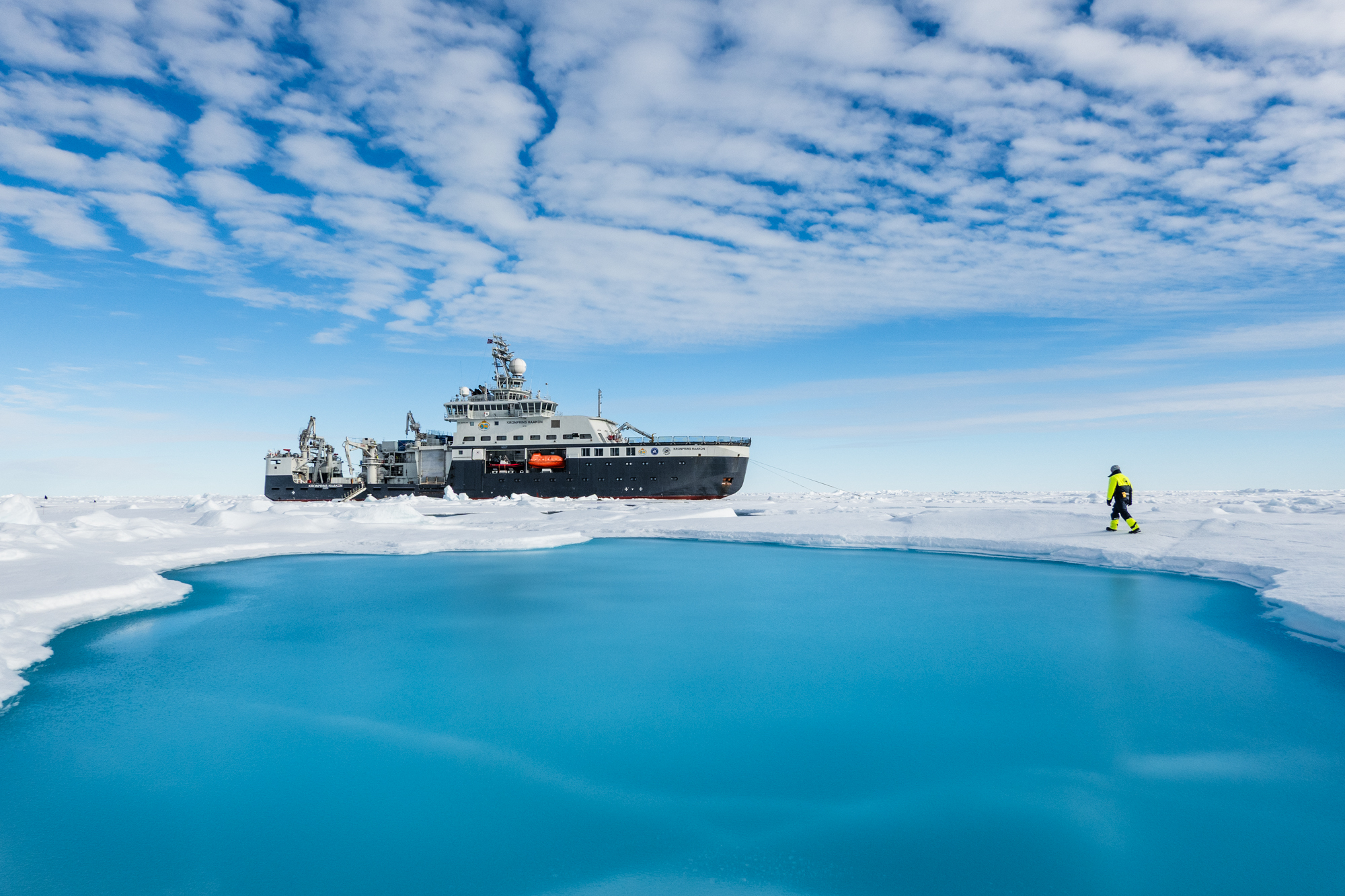
The national research programme Arctic Ocean 2050 brings together 18 Norwegian research institutions in a major interdisciplinary collaboration aimed at strengthening Norway’s knowledge base and strategic capacity in a rapidly changing Arctic Ocean. Its goals are to improve our understanding of the present-day Arctic Ocean and how it may change towards 2050, and develop the knowledge needed for future management, sustainable use, and a safe and secure region.
The ten-year program (2026–2035) combines basic research, applied science, and innovation – offering unique opportunities for professional development and cross-disciplinary collaboration.
Arctic Ocean 2050 focuses on processes within the Central Arctic Ocean, its interactions with the surrounding seas, and how these dynamics connect to broader climatic and political systems. Field activities will primarily take place in the Eurasian Basin, between Fram Strait and the North Pole, as well as including the adjacent continental slopes.
Pan-Arctic perspectives will be ensured through remote sensing, research on broader sociopolitical drivers, and modelling tools that cover the entire Arctic Ocean, and extensive international research collaboration.
Throughout the duration of the program, we work with diverse perspectives from various stakeholder and rightsholder groups for holistic understanding and development of policy solutions and scenarios that help mitigate risks.
Early career researchers will play a substantial role in the program, supported by educational and career-building opportunities.
Communication, outreach, solid program leadership and data management are integral elements of the program. These elements facilitate impact during the program and as its legacy.
Building international collaborations is essential for the success and pan-Arctic perspective of Arctic Ocean, especially towards and through the Synoptic Arctic Survey-II and the 5th International Polar Year.
Arctic Ocean 2050 is endorsed by the UN Decade of Ocean Science for Sustainable Development.
